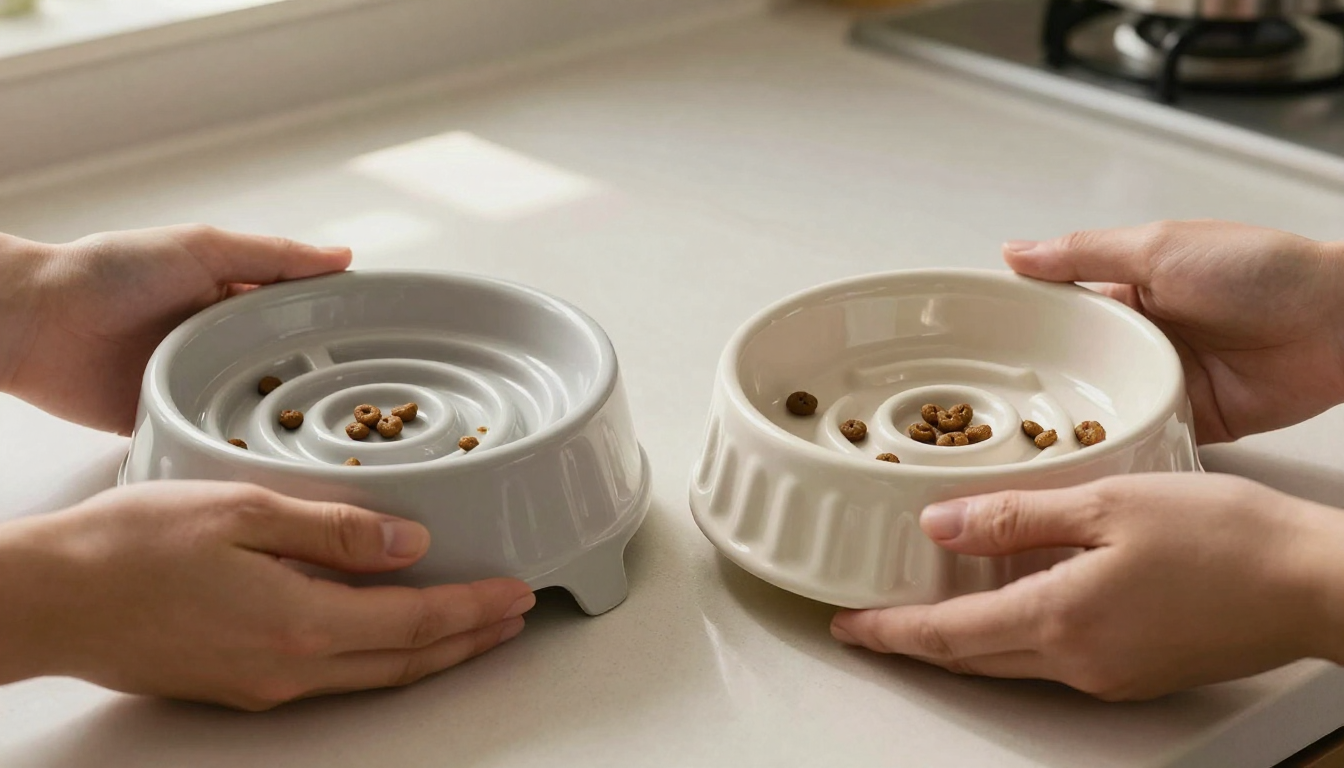
If you are shopping for a slow feeder bowl, the first decision is usually shape and size. The second — and arguably more important — decision is material. Ceramic and plastic are the two most common options, but they differ significantly in weight, hygiene, chemical safety, and durability. The wrong choice can turn a helpful feeding tool into a bacteria trap or a chew toy.
The quick answer: food-grade ceramic is the safer, heavier, and more stable choice if the glaze is certified lead-free and the bowl remains undamaged. BPA-free plastic is lighter, cheaper, and easier to find in complex maze designs, but it scratches more easily and can harbor more bacteria over time. For most owners, the best material depends on the dog: ceramic for bowl-flippers and plastic-avoiders, quality plastic for travel and complex patterns, and stainless steel when hygiene is the top priority.
Why Bowl Material Matters
Slow feeder bowls are designed to extend mealtime and reduce gulping. But the same ridges and crevices that slow down eating also create places where food residue, saliva, and bacteria can accumulate. The material of the bowl determines how easily those surfaces can be cleaned, how likely they are to scratch, and whether they can leach unwanted chemicals into food.
A 2018 study from Hartpury University Centre examined bacterial growth in dog water bowls made from plastic, ceramic, and stainless steel. Researchers found that bacteria increased significantly on all materials between day 0 and day 14. While there was no statistically significant difference in total bacterial load across the three materials, plastic bowls had the highest remaining bacterial counts at the end of the study, and ceramic bowls harbored the greatest diversity of bacterial species — including medically important pathogens such as MRSA and Salmonella. The takeaway is not that one material is sterile, but that cleaning practices matter enormously regardless of material.
Veterinary consensus generally ranks materials this way:
- Stainless steel (304/18-8 or 316) — most hygienic and durable
- Certified lead-free ceramic — heavy and stable, safe if undamaged
- High-quality BPA-free plastic — affordable and versatile, but wears faster
Plastic Slow Feeder Bowls
Plastic slow feeders dominate the market because they are inexpensive, lightweight, and easy to mold into elaborate maze patterns. The Outward Hound Fun Feeder line is the best-known example, and for many dogs it is perfectly adequate.
Pros
- Affordable. Most plastic slow feeders cost between $8 and $18.
- Lightweight. Easy to move, travel with, or swap between feeding stations.
- Complex designs. Plastic can be molded into intricate ridges and channels that challenge determined gulpers.
- Widely available. Nearly every pet retailer stocks multiple sizes and colors.
Cons
- Scratches easily. Deep scratches create grooves where bacteria and biofilm hide. A scratched plastic bowl should be replaced.
- Chemical concerns. Even BPA-free plastic may contain phthalates, plasticizers, or replacement bisphenols that can act as endocrine disruptors. Heat and UV exposure can accelerate leaching.
- Less stable. Lightweight bowls slide or flip more easily, especially on smooth floors or with enthusiastic eaters.
- Chew risk. Some dogs mouth or chew the plastic edges, which can create sharp spots or be ingested.
What to look for
If you choose plastic, look for:
- Explicit “BPA-free and phthalate-free” labeling
- FDA food-contact or food-grade certification
- Thick, durable plastic that resists cracking
- A non-slip base
- A design with wide enough channels to scrub clean
Ceramic Slow Feeder Bowls
Ceramic slow feeders are heavier, more stable, and free of plastic chemicals. They are a popular choice for owners who want to avoid plastic or whose dogs flip lighter bowls. However, ceramic comes with its own set of considerations.
Pros
- Heavy and stable. A ceramic bowl stays put on hardwood, tile, and other smooth surfaces.
- No plastic contact. Food does not touch plasticizers, BPA, or phthalates.
- Smooth, hard surface. A quality glaze resists scratches better than plastic.
- Dishwasher and microwave safe. Most ceramic bowls can be sanitized in the dishwasher.
Cons
- Can chip or crack. Dropped ceramic bowls can develop chips that harbor bacteria or sharp edges.
- Glaze safety varies. Cheap or imported ceramics may contain lead or cadmium in the glaze. Only buy bowls labeled food-safe, lead-free, and from reputable manufacturers.
- Limited designs. Ceramic is harder to mold into complex maze patterns than plastic.
- Higher price. Ceramic slow feeders typically cost $18–$30.
What to look for
If you choose ceramic, look for:
- Lead-free, food-safe glaze
- Made in USA, EU, or by a reputable manufacturer with published safety testing
- No chips, cracks, or crazing (fine surface cracks in the glaze)
- A weight that matches your dog’s size and enthusiasm
Head-to-Head Comparison
| Factor | Plastic Slow Feeder | Ceramic Slow Feeder | Stainless Steel Slow Feeder |
|---|---|---|---|
| Safety | Good if BPA/phthalate-free; scratches are the main risk | Excellent if lead-free and undamaged; chips are a concern | Best overall; non-porous and inert |
| Durability | Moderate; can crack or scratch | Long-lasting but breakable if dropped | Excellent; resists scratches and cracks |
| Weight | Light | Heavy | Moderate |
| Stability | Fair to good; depends on non-slip base | Excellent; rarely tips or slides | Good; heavier than plastic |
| Cleaning | Easy; top-rack dishwasher safe | Easy; dishwasher safe | Easiest; dishwasher safe and non-porous |
| Design variety | Excellent; complex mazes available | Limited; mostly simple ridges | Limited; fewer slow-feeder options |
| Price | $8–$18 | $18–$30 | $12–$25 |
| Best for | Travel, complex patterns, budget buyers | Bowl-flippers, plastic-free homes | Hygiene-focused owners, chewers |
Our Top Picks by Material
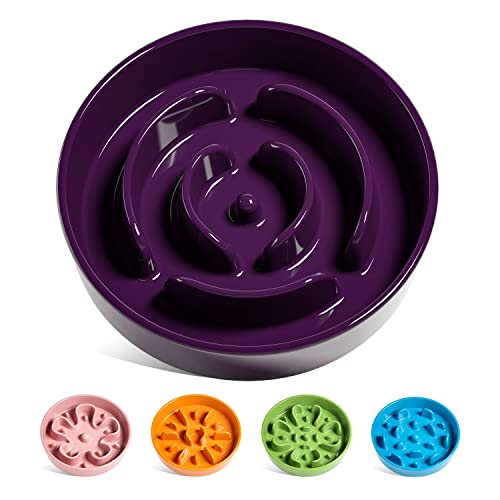 Best Ceramic
LE TAUCI Ceramic Slow Feeder Dog Bowl
Best For: Dogs that flip bowls; owners avoiding plastic
Material: Lead-free ceramic
Capacity: 1.5 cups
What We Like
- Heavy and stable
- No plastic contact with food
- Microwave and dishwasher safe
- Smooth glaze resists scratches
What We Don't Like
- Can chip or crack if dropped
- Limited to small and medium dogs
- Higher price than plastic
The LE TAUCI Ceramic Slow Feeder Bowl is our top ceramic pick. Its roughly two-pound weight keeps it in place on most floors, and the lead-free glaze avoids the chemical concerns associated with plastic. The maze pattern is simpler than some plastic bowls, but it still extends mealtime for small to medium dogs that eat too fast.
The main caveat is fragility. If your dog is prone to carrying the bowl around or you have hard floors, ceramic may not be the best choice. Daily cleaning — ideally in the dishwasher — keeps the glaze hygienic and prevents the bacterial buildup that the Hartpury study associated with ceramic surfaces.
 Best Plastic
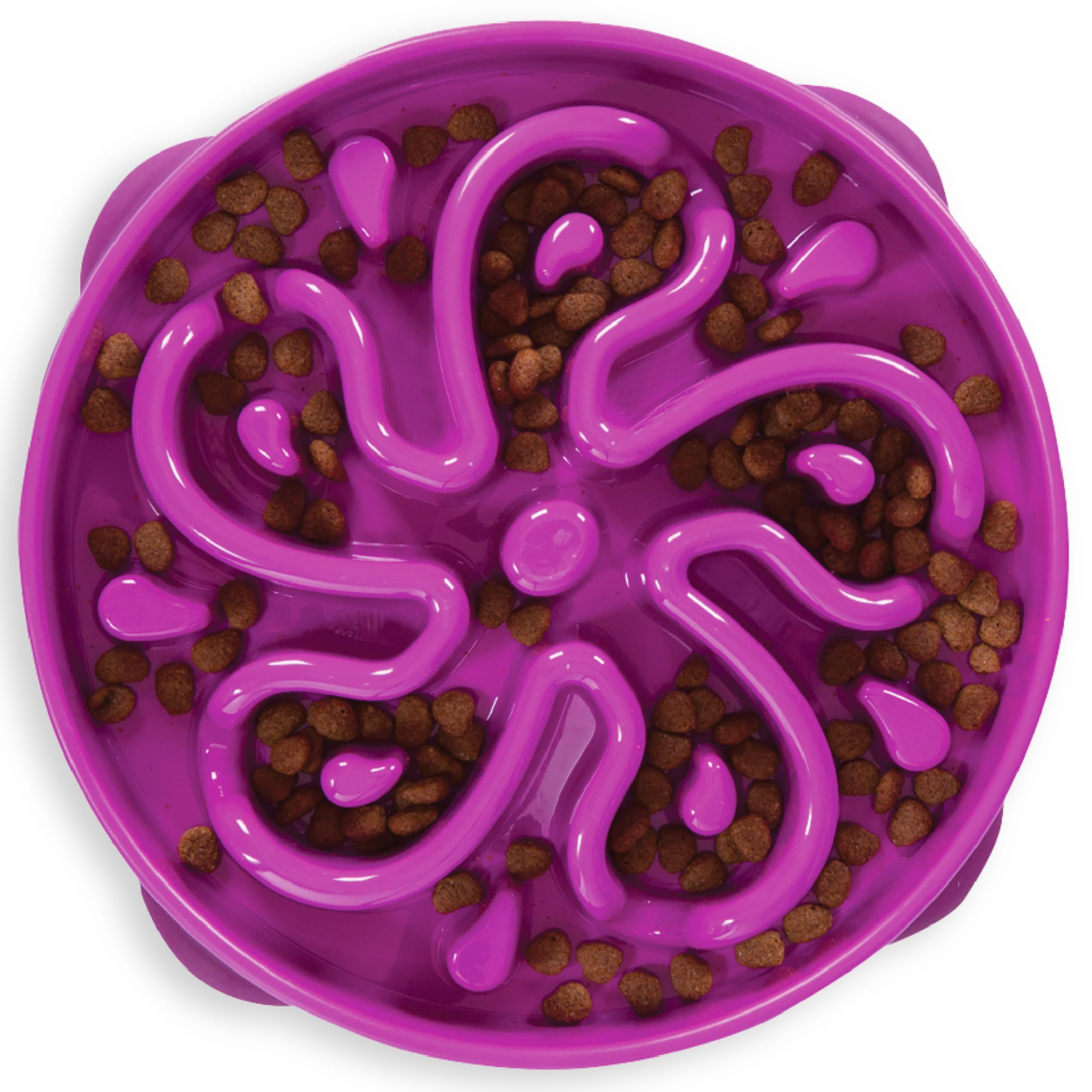
Outward Hound Fun Feeder Slo Bowl
Best For: Most dogs, especially fast eaters under 70 lb
Material: BPA-free plastic
Capacity: Up to 4 cups in large size
What We Like
- Maze pattern slows eating
- Non-slip base
- Top-rack dishwasher safe
- Multiple sizes and colors
What We Don't Like
- Small sizes can be flipped by determined dogs
- Not ideal for flat-faced breeds
- Can scratch and harbor bacteria
The Outward Hound Fun Feeder Slo Bowl is the benchmark plastic slow feeder. Its maze design is more complex than most ceramic options, which makes it effective for dogs that need a real challenge. We recommend it for owners who want an affordable, widely available bowl with proven slowing power.
The trade-off is longevity. Inspect the bowl regularly for deep scratches, and replace it when the surface starts to hold residue or show chew marks. For dogs that eat wet food, daily washing is especially important because plastic can retain odors and biofilm more readily than ceramic or steel.
 Best Hygiene
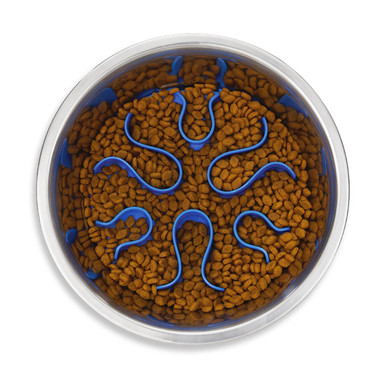
Outward Hound Fun Feeder Stainless Steel Slo Bowl
Best For: Owners who want the most hygienic, durable option
Material: Stainless steel with removable plastic insert
Capacity: 2 cups
What We Like
- Most hygienic material per veterinary research
- Removable insert doubles as standard bowl
- Dishwasher safe
- Won't crack or chip
What We Don't Like
- Heavier than plastic
- Can be noisy for metal-tag dogs
- Only 2-cup capacity
If the ceramic-vs-plastic debate leaves you unsure, the Outward Hound Fun Feeder Stainless Steel Slo Bowl is a strong third option. Stainless steel is the most hygienic bowl material according to veterinary research because it is non-porous and resists scratches. The removable plastic insert provides the slowing function while keeping food contact with steel to a minimum.
This bowl is best for small to medium dogs. It holds only two cups, so very large breeds may need a different solution. We cover large-breed options in our guide to the best slow feeder for large dogs.
 Best Budget Plastic
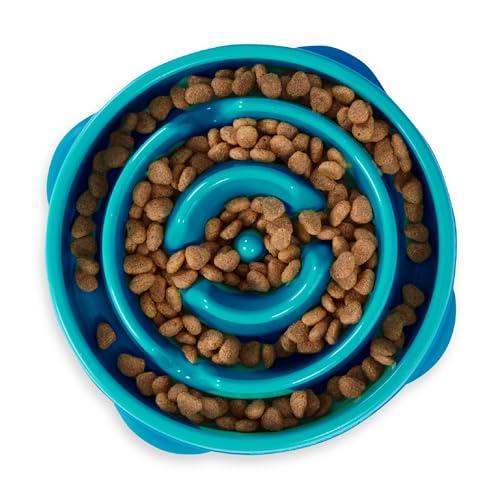
Outward Hound Fun Feeder Slo Bowl, Medium/Mini
Best For: Small dogs, puppies, and first-time buyers
Material: BPA-free plastic
Capacity: Up to 2 cups
What We Like
- Lowest-cost entry point
- Same proven maze design
- Top-rack dishwasher safe
- Compact for travel
What We Don't Like
- Too small for dogs over 30 lb
- Lightweight and easier to flip
- Same scratch concerns as larger plastic bowls
The Outward Hound Fun Feeder Slo Bowl, Medium/Mini is the lowest-risk way to test whether your dog will tolerate a slow feeder. It uses the same maze design as our top plastic pick but costs less and holds about two cups. We recommend it for small dogs, puppies, or as a travel backup rather than the primary bowl for a large, enthusiastic eater.
Best Use Cases
Choose ceramic if:
- Your dog flips or pushes lightweight bowls across the floor
- You want to avoid plastic entirely
- You have a small to medium dog that eats politely
- You can commit to daily dishwasher cleaning
- You are willing to replace the bowl if it chips
Choose plastic if:
- You need a complex maze design for a determined gulper
- You travel frequently and need a lightweight bowl
- You are on a tight budget
- Your dog does not chew or mouth the bowl
- You are prepared to inspect and replace it when scratched
Choose stainless steel if:
- Hygiene is your top priority
- Your dog chews plastic bowls
- You want a bowl that will last for years
- You do not mind a simpler slow-feeder design
FAQs
Frequently Asked Questions
Are ceramic dog bowls safer than plastic?
Ceramic bowls are generally safer than plastic in terms of chemical leaching, provided the glaze is certified lead-free and food-safe. They are also heavier and more stable. However, ceramic can chip or crack, and damaged ceramic can harbor bacteria. Plastic bowls are safe if labeled BPA-free and phthalate-free, but they scratch more easily and can retain bacteria in those scratches.
Can ceramic dog bowls contain lead?
Yes, especially cheap or imported decorative ceramics. Lead and cadmium are most often found in glazes. Choose bowls explicitly labeled lead-free, food-safe, or food-grade, and buy from reputable manufacturers. Avoid vintage or hand-crafted bowls unless they have been tested for food safety.
Is BPA-free plastic safe for dogs?
BPA-free plastic is safer than conventional plastic, but it is not risk-free. Some BPA-free plastics contain replacement bisphenols or phthalates that may also act as endocrine disruptors. Look for bowls labeled both BPA-free and phthalate-free, and avoid heating plastic bowls or leaving them in direct sunlight.
Do plastic bowls cause dog acne?
Plastic bowls have been associated with chin acne in both dogs and cats, likely because bacteria accumulate in scratches on the surface and transfer to the skin during eating. Switching to stainless steel or ceramic and cleaning the bowl daily often resolves the issue.
How often should I replace a plastic slow feeder bowl?
Replace a plastic slow feeder bowl when you notice deep scratches, cloudiness, discoloration, chew marks, or a persistent odor that does not wash away. For many households, this is every 6 to 12 months depending on the dog and cleaning routine.
Can I put ceramic and plastic slow feeders in the dishwasher?
Most high-quality ceramic and plastic slow feeders are top-rack dishwasher safe. Always check the manufacturer's label. Dishwasher cleaning is recommended because the high heat helps kill bacteria that hand-washing might miss.
Final Verdict
Both ceramic and plastic slow feeders can help a fast eater, but they serve slightly different households. Ceramic is the better choice for owners who want a stable, plastic-free bowl and are willing to handle it carefully to avoid chips. Plastic is the better choice for owners who need a lightweight, affordable, or complex maze design — as long as they inspect and replace the bowl when it wears out.
For the best of both worlds, consider stainless steel as a third option. It offers the hygiene of ceramic with the durability of neither, and it avoids the chemical concerns of plastic entirely.
No matter which material you choose, the most important factor is cleanliness. Wash the bowl daily, check for damage weekly, and replace it at the first sign of deep scratches or cracks. For more feeding guidance, see our picks for the best slow feeder dog bowls, our slow feeder bowl size guide, and our advice on why dogs eat too fast.
References
- Wright, C. & Carroll, A. (2018). “Microbiological assessment of canine drinking water and the impact of bowl construction material.” Hartpury University Centre. Presented at the 69th Annual Meeting of the European Federation of Animal Science, Dubrovnik. https://hartpuryresearchjournal.wordpress.com/2018/08/29/microbiological-assessment-of-canine-drinking-water-the-impact-of-construction-material-on-the-quantity-and-species-of-bacteria-present-in-water-bowls/
- “Counseling Clients on Food Bowl Selection: What’s the Dish?” Today’s Veterinary Nurse, 2022. https://www.todaysveterinarynurse.com/wp-content/uploads/sites/3/2022/03/TVN-2022-02_Pet_Bowls.pdf
- “The Bowl Truth.” Today’s Veterinary Business. https://todaysveterinarybusiness.com/pet-food-bowl-safety/
- “Pet feeding habits and the microbiological contamination of dog food bowls: effect of feed type, cleaning method and bowl material.” ResearchGate, 2023. https://www.researchgate.net/publication/376311177_Pet_feeding_habits_and_the_microbiological_contamination_of_dog_food_bowls_effect_of_feed_type_cleaning_method_and_bowl_material
- “Phthalates in dogs and cats.” PETSVETCHECK. https://petsvetcheck.de/en/diseases-and-disorders/poisonings/poisoning-from-a-z/phthalates/
- “How to Avoid Buying Pet Products with Toxic Chemicals.” LeafScore. https://www.leafscore.com/eco-friendly-pet-products/how-to-avoid-buying-pet-products-with-toxic-chemicals/
- “Plastic, Stainless Steel, Stoneware, Silicone or Ceramic Bowls?” Hemopet. https://hemopet.org/food-water-bowls-companion-pets/
- “Non-Toxic Pet Food Bowls (Lead & PFAS Tested).” NonToxic Lab. https://nontoxiclab.com/non-toxic-pet-food-bowls-lead-pfas-tested/