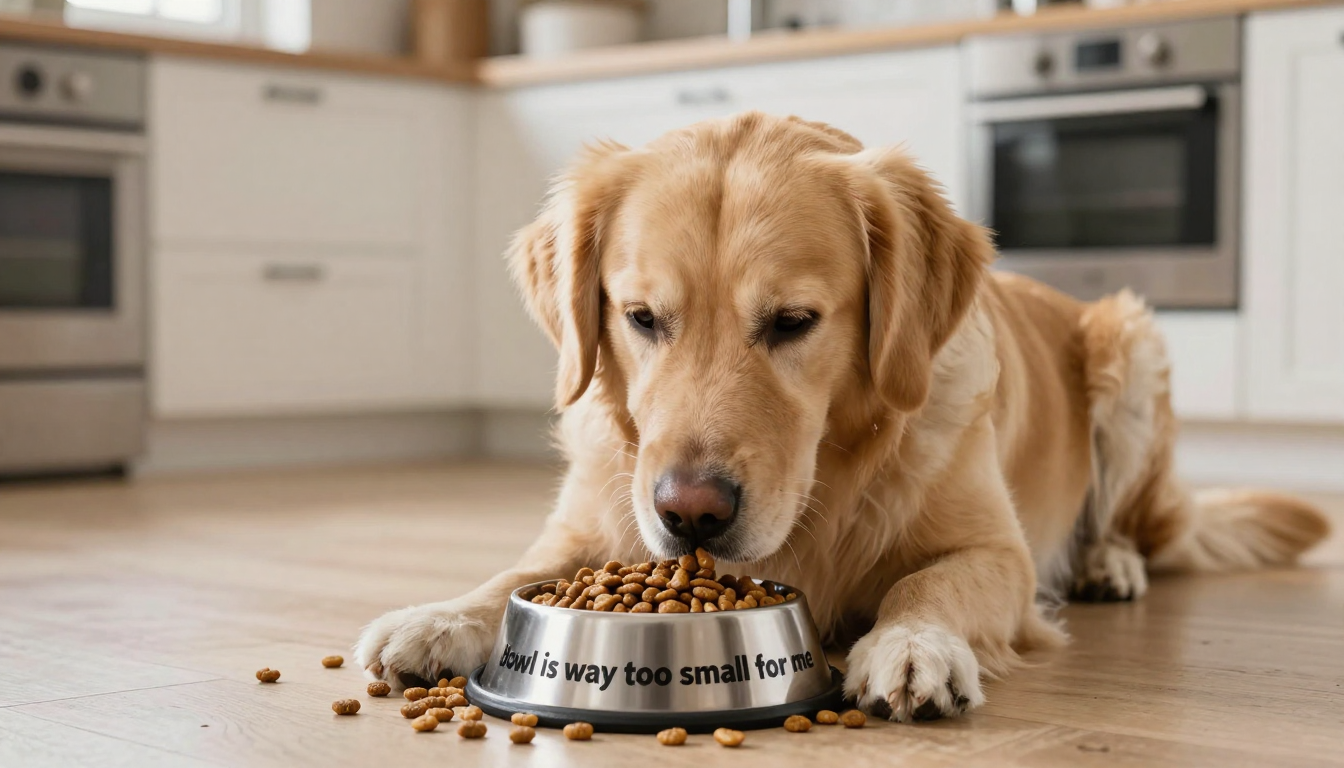
Buying the right slow feeder is not just about slowing down a fast eater. The wrong size can make mealtime stressful, ineffective, or even unsafe. A bowl that is too small spills food onto the floor. A bowl that is too deep frustrates a flat-faced dog. A maze that is too complex for a first-time user can trigger anxiety rather than calm eating.
This guide walks you through the three measurements that matter most — capacity, diameter/depth, and maze complexity — with breed-specific recommendations and calorie-based capacity rules. We also explain why a slow feeder is not one-size-fits-all, and how to match the bowl to your dog’s body shape, snout length, and eating style.
Why Size Matters
Slow feeders work by creating physical obstacles between your dog and the food. For that to work, the bowl must be large enough to hold the entire meal, shallow enough for the dog to reach the bottom, and complex enough to slow eating without causing frustration.
A 2016 study in Veterinary Evidence found that dogs using a “go slow” feeder ate significantly more slowly than when using a standard bowl. But the researchers also noted that dogs became faster with practice. That means the right level of difficulty is important: too easy and the dog returns to gulping; too hard and the dog may give up or become stressed.
Size also affects safety. Deep, narrow bowls can press against the whiskers or nose of flat-faced breeds, making breathing harder during eating. Bowls that are too small for large breeds force the dog to eat with its head twisted, which is uncomfortable and may increase swallowed air.
The Three Measurements That Matter
1. Capacity: Will the bowl hold one full meal?
Capacity is the simplest measurement. A slow feeder should hold your dog’s entire single-meal portion with a little room left for the food to move through the maze. As a starting point:
- Toy breeds (under 10 lb): 0.5–1 cup
- Small breeds (10–25 lb): 1–2 cups
- Medium breeds (25–55 lb): 2–4 cups
- Large breeds (55–90 lb): 4–6 cups
- Giant breeds (over 90 lb): 6–10+ cups
These are volume estimates. Because kibble density varies, a more accurate approach is to calculate daily calories and split them into meals. The AAHA/WSAVA formula for resting energy requirement is:
RER (kcal/day) = (30 × body weight in kg) + 70
Multiply RER by a life-stage factor to get maintenance energy requirement (MER): about 1.6 for a neutered adult, 1.8 for an intact adult, and 1.2–1.4 for a less active senior. Then divide daily calories by your food’s kcal per cup to find the meal volume.
Example: A 40 lb (18.2 kg) neutered adult dog on a food with 365 kcal/cup needs roughly 800 kcal per day, or about 2.2 cups total. Split into two meals, each meal is about 1.1 cups, so a 2-cup slow feeder is appropriate.
2. Diameter and depth: Can your dog eat comfortably?
The bowl should be wide enough for your dog’s muzzle and shallow enough for the tongue to reach every corner. A useful rule of thumb is that the bowl diameter should be roughly 2 to 2.5 times the length of your dog’s snout.
Depth matters too:
- Toy and small dogs: rim height under 1.5 inches
- Medium dogs: rim height 1.5–2.5 inches
- Large and giant dogs: rim height 2.5–3.5 inches
Flat-faced breeds need especially shallow, wide bowls. Deep mazes can press the nose and make breathing difficult. Long-snouted breeds can handle deeper channels.
3. Maze complexity: Is the puzzle matched to your dog?
Maze complexity ranges from simple ridges to multi-level labyrinths. Start simple and increase difficulty only if your dog still eats too quickly. Signs that the maze is too hard include whining, pawing at the bowl, walking away, or taking more than 20 minutes to finish a normal meal.
Size Guide by Breed and Weight
| Size category | Weight | Examples | Bowl diameter | Rim height | Capacity | Maze complexity |
|---|---|---|---|---|---|---|
| Toy | Under 10 lb | Chihuahua, Yorkie, Maltese, Pomeranian | 5–7 in | Under 1.5 in | 0.5–1 cup | Very simple |
| Small flat-faced | 10–25 lb | French Bulldog, Pug, Boston Terrier, Shih Tzu | 6–8 in | 1.0–1.5 in | 1–2 cups | Shallow and open |
| Small long-snout | 10–25 lb | Dachshund, Mini Schnauzer, Beagle | 6–8 in | 1.5–2 in | 1–2 cups | Simple to moderate |
| Medium | 25–55 lb | Border Collie, Cocker Spaniel, Bulldog | 7–9 in | 1.5–2.5 in | 2–4 cups | Moderate |
| Large | 55–90 lb | Labrador, Golden Retriever, German Shepherd | 9–10.5 in | 2–3 in | 4–6 cups | Moderate to complex |
| Giant | Over 90 lb | Great Dane, Saint Bernard, Mastiff | 10–12+ in | 2.5–3.5 in | 6–10+ cups | Complex or XL design |
This table is a starting point, not a strict rule. A highly food-motivated Labrador may need a more complex maze than a calm Golden Retriever of the same weight. A senior dog with dental pain may need shallower channels than a young adult of the same breed.
Special Cases
Flat-faced (brachycephalic) breeds
French Bulldogs, Pugs, Boxers, Boston Terriers, and English Bulldogs have short snouts and flattened faces. They need wide, shallow bowls with open grooves that do not press against the nose or whiskers. Avoid tall ridges and deep channels. Some companies make “flat-face feeders” specifically for this body type.
Long-snouted breeds
Dachshunds, Greyhounds, Collies, and German Shepherds can reach into deeper channels. They often do well with taller ridges and more complex maze patterns. However, the bowl must still be wide enough that the dog does not have to twist its neck to reach the corners.
Deep-chested breeds
Great Danes, Standard Poodles, Weimaraners, and Irish Setters are at higher risk for gastric dilatation-volvulus (bloat). Slowing down eating is important for these dogs, but the bowl should be floor-level. A 2000 study in the Journal of the American Veterinary Medical Association found that raised feeding bowls were associated with an increased risk of GDV in large- and giant-breed dogs.
Puppies and seniors
Puppies need smaller, shallower bowls than adult dogs of the same breed. Their snouts are shorter and their coordination is still developing. Senior dogs may have dental pain, neck stiffness, or reduced vision, so choose a bowl with wider channels and a lower rim.
Capacity Quick Reference
| Dog weight | Approx. daily kcal | Typical cups/day* | Cups per meal (2 meals) | Recommended bowl capacity |
|---|---|---|---|---|
| 5 lb | 140–200 | 0.4–0.6 | 0.2–0.3 | 0.5–1 cup |
| 15 lb | 320–450 | 0.9–1.2 | 0.5–0.6 | 1 cup |
| 30 lb | 550–750 | 1.5–2.1 | 0.8–1.1 | 2 cups |
| 50 lb | 850–1,100 | 2.3–3.0 | 1.2–1.5 | 3–4 cups |
| 70 lb | 1,100–1,400 | 3.0–3.8 | 1.5–1.9 | 4–5 cups |
| 90 lb | 1,350–1,700 | 3.7–4.7 | 1.9–2.4 | 5–6 cups |
| 120 lb | 1,700–2,100 | 4.7–5.8 | 2.4–2.9 | 6–8 cups |
*Assumes a dry kibble with approximately 365 kcal per cup. Adjust based on your specific food.
Our Top Picks by Size
 Best Overall Sizing Range
Outward Hound Fun Feeder Slo Bowl
Best For: Medium to large dogs (25–70 lb)
Material: BPA-free plastic
Capacity: Up to 4 cups in large size
What We Like
- Available in multiple sizes
- Proven maze design
- Non-slip base
- Top-rack dishwasher safe
What We Don't Like
- Small sizes can be flipped
- Not ideal for flat-faced breeds
- Can scratch over time
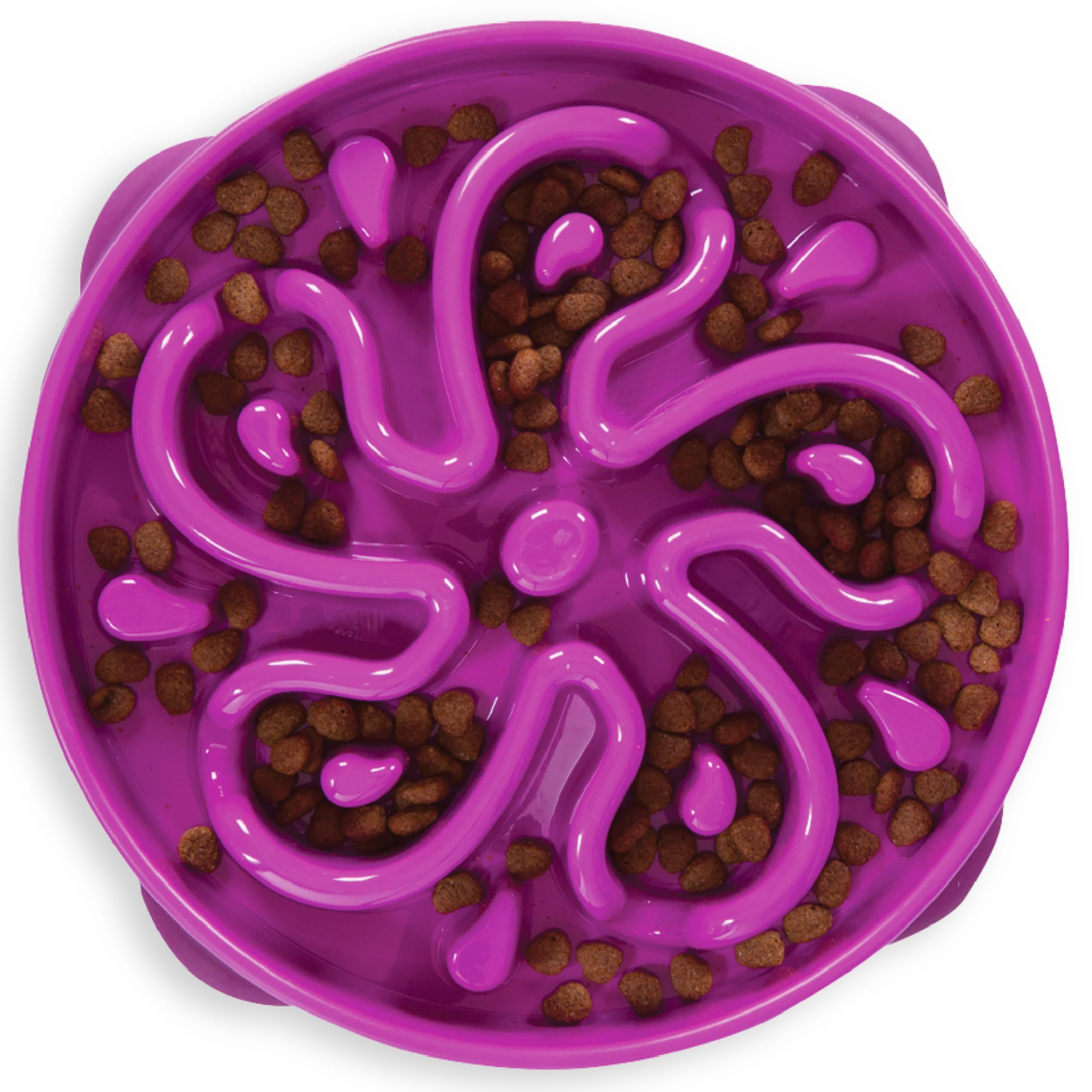
The Outward Hound Fun Feeder Slo Bowl is the most versatile size option. It comes in several sizes, with the large holding up to four cups of kibble. That makes it suitable for most medium and large breeds, as well as smaller dogs that eat large-volume kibble. We recommend it as the default choice when you are unsure which size to buy.
For dogs between 25 and 55 pounds, the medium or large size usually works best. For dogs over 70 pounds, the large size may only hold one meal if your dog eats more than four cups per day. In that case, consider splitting the meal between two bowls or reading our best slow feeder for large dogs guide.
 Best for Small Dogs
Outward Hound Fun Feeder Slo Bowl, Medium/Mini
Best For: Small dogs and puppies under 25 lb
Material: BPA-free plastic
Capacity: Up to 2 cups
What We Like
- Low profile for small snouts
- Same proven maze design
- Lightweight and portable
- Top-rack dishwasher safe
What We Don't Like
- Too small for dogs over 30 lb
- Easy to flip by larger dogs
- Limited capacity
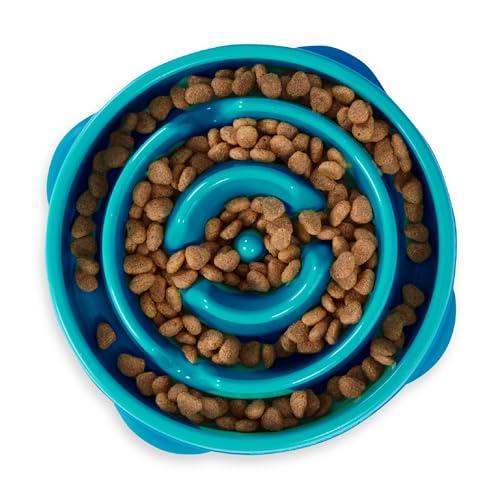
The Outward Hound Fun Feeder Slo Bowl, Medium/Mini is the best starting point for small breeds and puppies. Its lower rim and smaller diameter match shorter snouts, and the two-cup capacity is enough for most small-dog meals. Because it is lightweight, it is also a good travel bowl.
We do not recommend this size for dogs over 30 pounds as a primary bowl. A larger dog will flip it or finish the food too quickly because the maze is proportionally smaller relative to its muzzle.
 Best for Bowl Flippers
LE TAUCI Ceramic Slow Feeder Dog Bowl
Best For: Small to medium bowl-flippers (under 40 lb)
Material: Lead-free ceramic
Capacity: 1.5 cups
What We Like
- Heavy and stable
- Low center of gravity
- Dishwasher safe
- No plastic contact
What We Don't Like
- Limited to 1.5 cups
- Can chip if dropped
- Not suitable for giant breeds
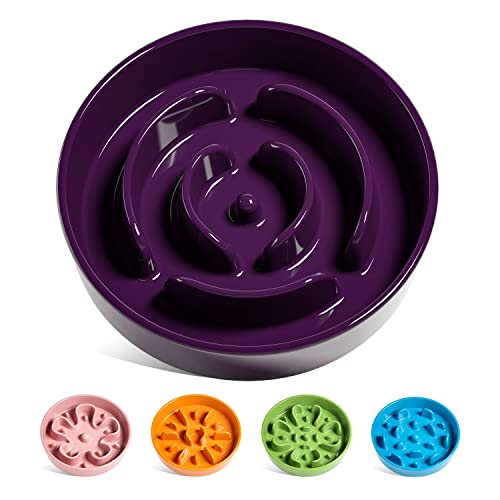
The LE TAUCI Ceramic Slow Feeder Bowl holds 1.5 cups, making it appropriate for small to medium dogs. Its main advantage is weight: at roughly two pounds, it stays put when dogs push or paw at it. This is useful for enthusiastic eaters that treat lightweight plastic bowls like hockey pucks.
Because of the 1.5-cup capacity, this bowl is not suitable for large or giant breeds unless you split meals. It is also ceramic, so handle it carefully to avoid chips.
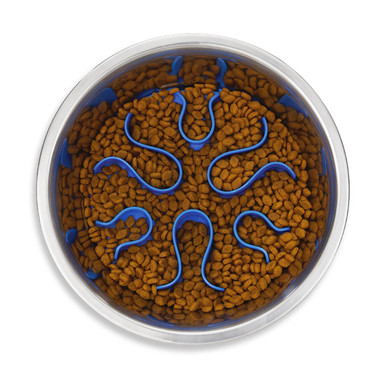 Best for Hygiene
Outward Hound Fun Feeder Stainless Steel Slo Bowl
Best For: Small to medium hygiene-focused owners
Material: Stainless steel with removable plastic insert
Capacity: 2 cups
What We Like
- Hygienic stainless steel base
- Removable insert for cleaning
- Dishwasher safe
- Won't crack or chip
What We Don't Like
- Only 2-cup capacity
- Can be noisy with metal tags
- Heavier than plastic
The Outward Hound Fun Feeder Stainless Steel Slo Bowl holds two cups and is the most hygienic option for small to medium dogs. The stainless steel base resists bacteria and scratches, while the removable plastic insert provides the slowing function. If your priority is easy cleaning and long-term durability over maximum capacity, this is the bowl to choose.
Common Sizing Mistakes
Buying by breed name alone
A “Labrador bowl” is not always the right size for every Labrador. Activity level, body condition, and kibble density all affect how much food the bowl needs to hold. Measure your dog’s meal and snout instead of relying on breed marketing.
Ignoring kibble size
Large kibble pieces take up more space than small kibble pieces. A bowl that holds four cups of small kibble may only hold three cups of large kibble. Check whether the kibble fits through the maze channels as well as into the overall capacity.
Choosing a bowl that is too complex
A complex maze does not automatically mean better results. If the dog cannot reach the food, it may give up or become anxious. Start with a moderate maze and increase difficulty only if needed.
Forgetting about snout shape
Flat-faced breeds need shallow, wide bowls. Long-snouted breeds can handle deeper channels. A bowl that is perfect for a Beagle may be frustrating for a Bulldog of the same weight.
FAQs
Frequently Asked Questions
How do I measure my dog for a slow feeder bowl?
Measure three things: (1) the volume of one meal in cups, (2) the length and width of your dog's snout, and (3) the height from the floor to your dog's lower lip when standing normally. Choose a bowl with capacity equal to or slightly larger than the meal, a diameter roughly 2–2.5 times snout length, and a rim height that lets your dog eat without straining its neck.
What size slow feeder for a 30 lb dog?
Most 30 lb dogs need a 2-cup slow feeder with a diameter of 7–8 inches and a rim height of 1.5–2 inches. Medium breeds like Beagles, Border Collies, and Cocker Spaniels usually fall into this range.
What size slow feeder for a 70 lb dog?
A 70 lb dog typically needs a 4–5 cup slow feeder with a diameter of 9–10.5 inches and a rim height of 2–3 inches. If your dog eats more than 4 cups per meal, look for an extra-large bowl or split the meal across two bowls.
Are slow feeders good for flat-faced dogs?
Yes, but only if they are shallow and wide. Deep mazes can press against a flat-faced dog's nose and make breathing harder. Look for bowls specifically marketed for brachycephalic breeds, with open grooves and a rim height under 1.5 inches.
Should I get a raised slow feeder for my large dog?
No. A 2000 JAVMA study found that raised feeding bowls were associated with an increased risk of gastric dilatation-volvulus (bloat) in large and giant breeds. Feed large dogs from floor-level bowls unless your veterinarian specifically recommends elevation for a medical condition.
Can I use a slow feeder for wet food?
Yes, but choose a bowl with wider channels and a shallower design so the wet food does not get trapped. Stainless steel and ceramic bowls are easier to clean after wet food meals than plastic. For very runny food, a lick mat may work better than a slow feeder bowl.
Final Verdict
The right slow feeder size depends on three measurements: capacity, diameter/depth, and maze complexity. Match the capacity to your dog’s single-meal portion, the diameter to roughly 2–2.5 times snout length, and the maze complexity to your dog’s experience level and snout shape.
For most medium dogs, the Outward Hound Fun Feeder Slo Bowl in large size is the safest default. For small dogs and puppies, choose the Medium/Mini version. For bowl-flippers, the LE TAUCI Ceramic Slow Feeder Bowl adds stability. For hygiene-focused owners with small to medium dogs, the Outward Hound Stainless Steel Slo Bowl is the most durable choice.
If your dog is a giant breed, a flat-faced breed, or has special medical needs, take the extra step to measure snout length and meal volume rather than guessing by breed. For more help, see our guides to the best slow feeder dog bowls, best slow feeders for large dogs, and why dogs eat too fast.
References
- Buckley, L.A. & Lees, J. (2016). “Go slow feeding bowls: how effective are they at getting dogs to eat more slowly?” Veterinary Evidence, 1(4). https://veterinaryevidence.org/index.php/ve/article/download/71/version/62/93
- AAHA. “2021 AAHA Nutrition and Weight Management Guidelines for Dogs and Cats.” https://www.aaha.org/aaha-guidelines/nutrition-weight-management/
- WSAVA. “Global Nutrition Guidelines.” https://wsava.org/global-guidelines/global-nutrition-guidelines/
- Glickman, L.T. et al. (2000). “Non-dietary risk factors for gastric dilatation-volvulus in large and giant breed dogs.” Journal of the American Veterinary Medical Association, 217(10), 1492–1499. https://avmajournals.avma.org/downloadpdf/journals/javma/217/10/javma.2000.217.1492.pdf
- “Counseling Clients on Food Bowl Selection: What’s the Dish?” Today’s Veterinary Nurse, 2022. https://www.todaysveterinarynurse.com/wp-content/uploads/sites/3/2022/03/TVN-2022-02_Pet_Bowls.pdf
- “Choosing the Right Bowl Size for Small Dogs.” Pet Care Shed. https://petcareshed.com.au/blogs/pet-supplies/choosing-the-right-bowl-size-for-small-dogs-pet-essentials-australia
- “How do slow feeder dog bowls work?” FeedSlowly. https://feedslowly.com/blogs/slow-feeder-dog-bowl/how-do-slow-feeder-dog-bowls-work