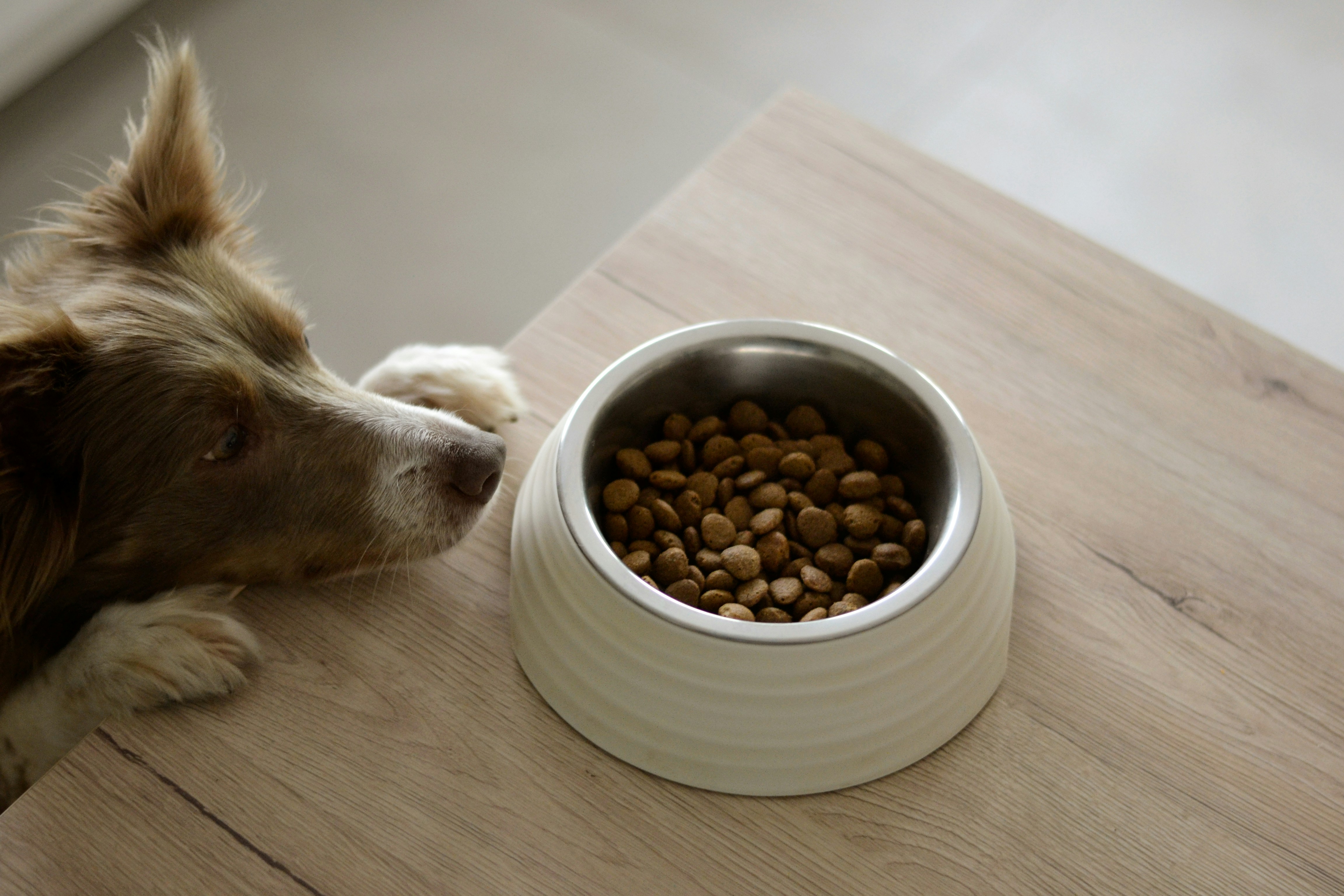
If your dog finishes dinner before you have sat down to eat yours, you are not alone. Many owners describe their dogs as “inhaling” food, barely chewing, and sometimes vomiting or regurgitating minutes later. Fast eating is one of the most common feeding complaints veterinarians hear, and it is not just a quirk. In deep-chested and large-breed dogs, rapid eating is a recognized risk factor for gastric dilatation-volvulus (GDV), commonly called bloat, a life-threatening emergency.
The good news is that most fast eating can be slowed safely at home. The first step is understanding why your dog does it. Reasons range from normal canine biology and past food competition to anxiety, diet composition, and underlying medical conditions. This guide explains the causes, separates dangerous signs from harmless habits, and shows you the tools that veterinary behaviorists and nutritionists recommend most often.
Why Dogs Eat Fast
Dogs are not designed to savor meals the way humans do. They have roughly 1,700 taste buds compared with about 9,000 in humans, and their ancestors ate opportunistically: when food was available, they consumed it quickly before another animal could take it. That evolutionary pressure still shapes eating behavior today.
1. Instinct and biology
In the wild, wolves and free-ranging dogs eat fast because a carcass or kill site attracts competitors. Speed reduces the chance of losing a meal. Modern pet dogs do not face the same threat, but the behavior is hardwired. Some breeds, especially working and sporting breeds with high food drive, are simply more motivated to eat quickly.
2. Competition with other pets
Even if your dogs have never missed a meal, the sight or smell of another pet eating can trigger competitive speed eating. This is common in multi-dog households and in dogs that were raised in large litters where the fastest eater got the most milk. Feeding dogs in separate rooms often reduces this effect within a few days.
3. Irregular meal timing or past food insecurity
Rescue dogs, former strays, and dogs with a history of inconsistent meals may eat quickly because food availability once felt unpredictable. A consistent feeding schedule helps these dogs learn that the next meal is coming, which gradually reduces panic eating.
4. Anxiety and stress
Anxious dogs may gulp food as a displacement behavior or because they feel unsafe in the feeding area. Loud households, nearby traffic, construction, or conflict with another pet can make a dog eat faster to get the meal over with. In some cases, fast eating becomes part of a broader pattern of food guarding or resource insecurity.
5. Diet composition
A diet that is very calorie-dense or low in fiber can leave a dog unsatisfied, leading to frantic eating at the next meal. Dogs fed a single large meal per day also tend to eat more quickly than dogs fed the same total amount split into two or three meals.
6. Medical causes
Sometimes fast eating is a symptom, not a habit. Conditions that increase appetite or discomfort around food include intestinal parasites, diabetes, Cushing’s disease, hypothyroidism, exocrine pancreatic insufficiency, inflammatory bowel disease, and certain medications such as prednisone. If your dog’s eating speed changed suddenly, or if it is accompanied by weight loss, increased thirst, diarrhea, or a potbelly, schedule a veterinary exam.
Is Fast Eating Dangerous?
For many dogs, fast eating causes minor problems: occasional regurgitation, post-meal restlessness, and swallowed air. For others, especially large and deep-chested breeds, it can be serious.
Choking and vomiting
When a dog gulps food without chewing adequately, pieces can lodge in the airway or esophagus. Even when nothing gets stuck, swallowed air can trigger regurgitation of undigested food shortly after eating. Repeated vomiting can irritate the esophagus and lead to poor nutrient absorption.
Gastric dilatation-volvulus (bloat)
Bloat is the most dangerous risk associated with fast eating. In GDV, the stomach fills with gas and twists on itself, cutting off blood supply. It is painful, progresses rapidly, and can be fatal without emergency surgery.
A landmark prospective cohort study published in the Journal of the American Veterinary Medical Association followed 1,637 large- and giant-breed dogs for approximately five years. The researchers found that faster eating speed was a significant risk factor for GDV in large-breed dogs. Risk increased by roughly 38% per unit increase on a 1-to-10 eating-speed scale. The same study also identified raised feeding bowls as a risk factor, which is why many veterinarians now recommend feeding from floor-level bowls.
More recently, a 2016 knowledge summary in Veterinary Evidence reviewed the available literature and concluded that evidence on eating speed and GDV is mixed but directionally consistent: when studies do find an effect, fast eating is always the risk factor, and slow eating is never implicated as harmful. Cornell University’s Riney Canine Health Center and the American College of Veterinary Surgeons continue to list rapid eating among accepted GDV risk factors alongside deep-chested body shape, breed predisposition, advanced age, and single large meals.
When to call a vet immediately
Seek emergency care if fast eating is followed by any of the following:
- A distended, hard abdomen
- Unproductive retching or attempts to vomit
- Restlessness, pacing, or inability to settle
- Excessive drooling
- Pale gums or collapse
These are classic signs of bloat and require immediate intervention.
5 Research-Backed Ways to Slow Down a Fast Eater
Most fast eaters respond to one or more of the following strategies. The goal is not to frustrate the dog but to extend mealtime from under a minute to 5–15 minutes, which reduces swallowed air and improves digestion.
1. Use a slow feeder bowl
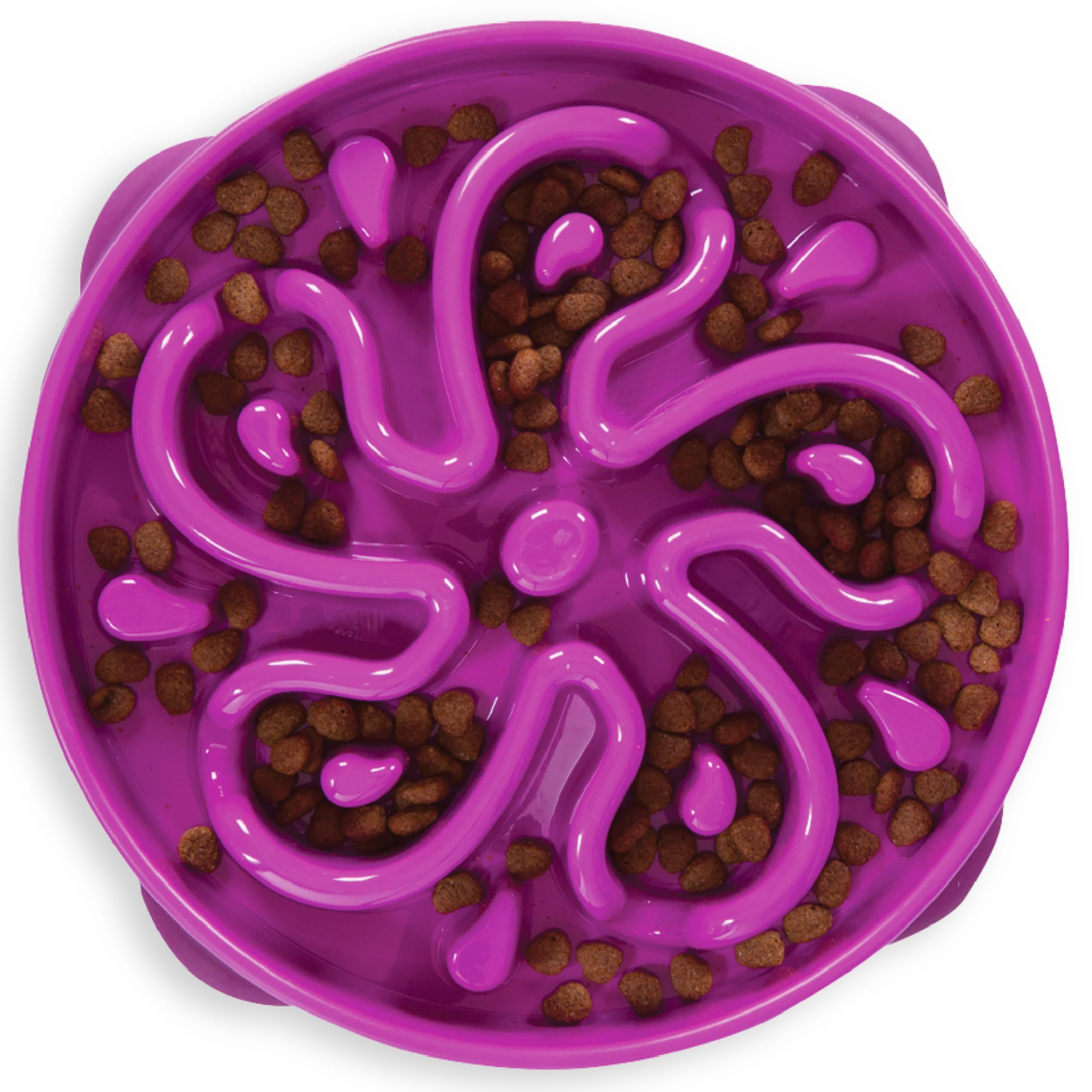
Slow feeder bowls have ridges, mazes, or obstacles that force a dog to eat around them. A 2016 peer-reviewed study in Veterinary Evidence found that dogs eating from a “go slow” feeder took significantly longer to finish a meal than when using a standard bowl, and they remained slower even after gaining experience with the bowl.
For most households, the Outward Hound Fun Feeder Slo Bowl is the easiest starting point. For dogs that flip lightweight bowls, a ceramic slow feeder is often a better choice.
2. Try a puzzle feeder or stuffable toy
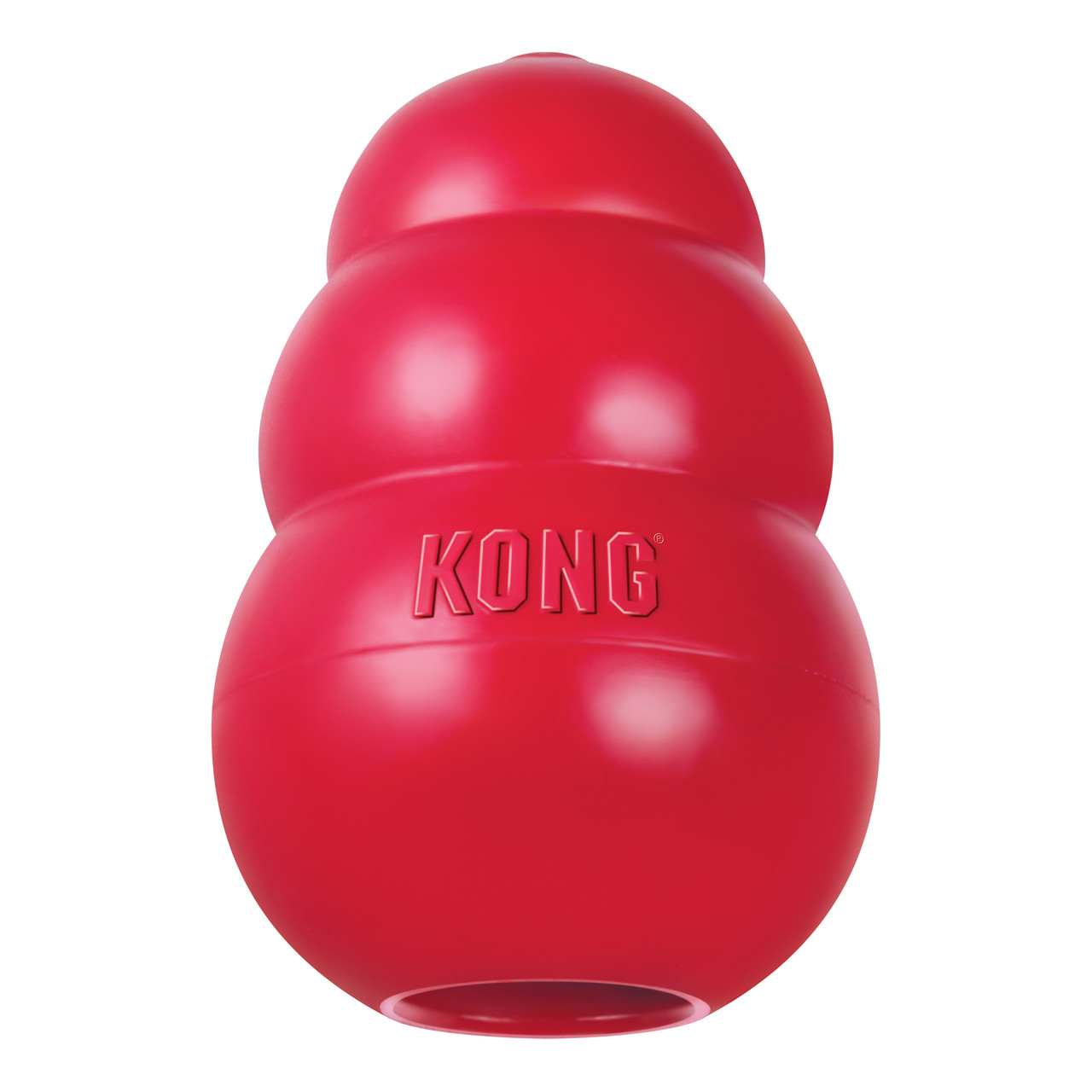
Puzzle feeders turn a meal into a problem-solving task. For dogs that eat kibble, a board puzzle like the Nina Ottosson by Outward Hound line works well. For dogs that eat wet or raw food, a stuffable rubber toy such as the KONG Classic is more versatile. Stuffing and freezing the toy extends engagement time from a few minutes to 20–30 minutes.
3. Add a lick mat
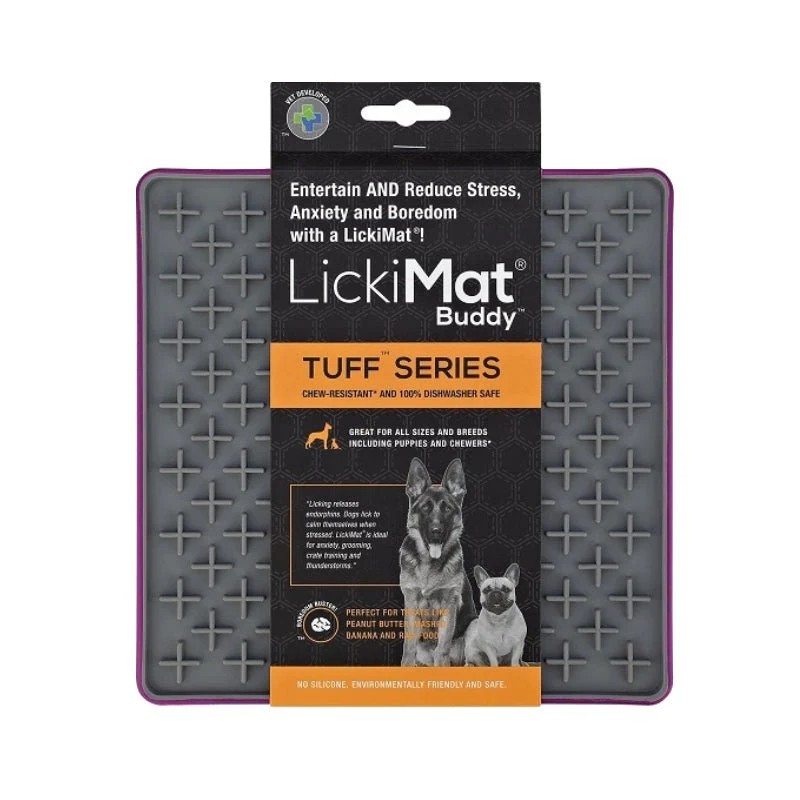
Lick mats are flat textured surfaces smeared with wet food, yogurt, or peanut butter. They are particularly useful for anxious dogs because repetitive licking is self-soothing. A 2021 study in Applied Animal Behaviour Science reported that food-licking activities can lower cortisol in dogs. The LickiMat Tuff Buddy is a durable, dishwasher-safe option that works with most spreads.
4. Split meals
Feeding the same daily amount in two or three smaller meals reduces the chance that a dog arrives at the bowl ravenous. This is especially important for deep-chested breeds at risk of GDV. Most veterinarians recommend at least two meals per day for adult dogs.
5. Train calm mealtime behavior
Teaching a dog to wait for a release cue before eating can reduce pre-meal arousal. Start by asking your dog to sit before placing the bowl, then release them with a calm word. Over time, this creates a more relaxed emotional state around food. Feeding in a quiet area away from household traffic also helps anxious eaters.
Top Tools to Slow Down a Fast Eater
 Best First Slow Feeder
Outward Hound Fun Feeder Slo Bowl
Best For: Most dogs that gulp kibble or wet food
Material: BPA-free plastic
Capacity: Up to 4 cups in large size
What We Like
- Maze pattern slows eating
- Non-slip base
- Top-rack dishwasher safe
- Multiple sizes and colors
What We Don't Like
- Small sizes can be flipped by determined dogs
- Not ideal for flat-faced breeds
- Deep channels can frustrate some dogs
The Outward Hound Fun Feeder Slo Bowl is the benchmark most other slow feeders are measured against. Its raised ridges and valleys turn a 30-second gulp into a 5-to-10-minute meal, which aligns with the slowing effect documented in the Veterinary Evidence study. We recommend it as the first tool for owners whose dogs eat dry kibble too quickly.
The bowl comes in several sizes and colors, so you can match capacity to your dog’s meal size. The BPA-free plastic is lightweight but thick enough to resist chewing, and the rubberized base keeps it from sliding across the floor. If your dog is a “bowl flipper,” choose the large size or upgrade to the ceramic option below. For more options, see our complete guide to the best slow feeder dog bowls.
 Best Stuffable Feeder
KONG Classic Dog Toy
Best For: Dogs that need mental stimulation during meals
Material: Natural rubber
Capacity: Holds treats, kibble, or wet food
What We Like
- Can be stuffed and frozen for longer engagement
- Recommended by vets and trainers
- Durable for average chewers
- Dishwasher safe
What We Don't Like
- Not ideal for power chewers without sizing up
- Can roll under furniture
- Some dogs need help learning to use it
The KONG Classic is a hollow rubber toy that can be packed with kibble, wet food, plain yogurt, or xylitol-free peanut butter, then frozen to extend engagement time. It is widely recommended by veterinary behaviorists for dogs with separation anxiety and for any dog that inhales food from a bowl.
We recommend the KONG as a meal-delivery tool rather than a bowl replacement. For a dog that eats a full cup of kibble in seconds, splitting the meal between a slow feeder bowl and a frozen KONG can double or triple feeding time. The ASPCA specifically recommends long-lasting food toys as part of a counterconditioning plan for mild separation anxiety. Read more in our guide to best puzzle feeders for anxious dogs.
 Best Calming Option
LickiMat Tuff Buddy
Best For: Anxious dogs and dogs that benefit from licking
Material: Non-toxic food-grade TPR rubber with PP base
Capacity: 20 × 20 cm (8" × 8")
What We Like
- Durable Tuff construction
- Dishwasher and freezer safe
- Works with wet, dry, raw, and liquid foods
- Non-slip rubber feet
What We Don't Like
- Not indestructible for aggressive chewers
- No suction cups
- Grooves can trap food if not washed promptly
The LickiMat Tuff Buddy uses a crosshatch texture to spread food across a wide surface, which naturally slows licking and can reduce gulping. Because licking is self-soothing, the mat is especially useful for dogs that eat fast due to anxiety, overexcitement, or stress.
We recommend the Tuff Buddy as a complement to a slow feeder bowl, not a replacement for full meals. Use it for breakfast toppers, bedtime snacks, or during thunderstorms and grooming. It is freezer safe and top-rack dishwasher safe, making it easy to incorporate into daily routines. For more lick mat picks, see our guide to the best lick mats for dogs.
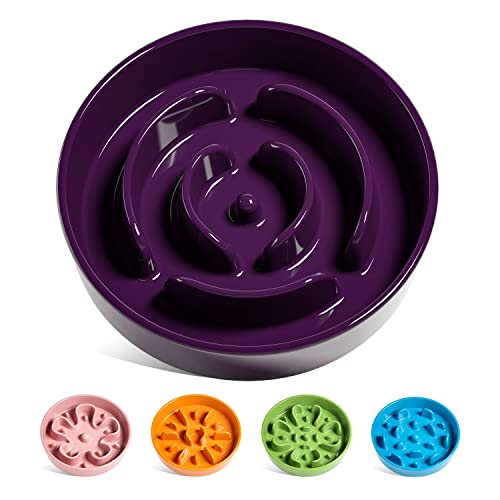 Best for Bowl Flippers
LE TAUCI Ceramic Slow Feeder Dog Bowl
Best For: Dogs that flip plastic bowls; owners avoiding plastic
Material: Lead-free ceramic
Capacity: 1.5 cups
What We Like
- Heavy and stable
- No plastic contact with food
- Microwave and dishwasher safe
- Smooth glaze resists scratches
What We Don't Like
- Can chip or crack if dropped
- Limited to small and medium dogs
- Higher price than plastic
The LE TAUCI Ceramic Slow Feeder Bowl is our recommendation for owners whose dogs treat lightweight plastic bowls like hockey pucks. At roughly two pounds, it stays put on hardwood and tile, and the smooth, lead-free glaze is easier to sanitize than scratched plastic.
Ceramic bowls do require careful handling: they can chip if dropped, and research from Hartpury University found that ceramic can harbor a diverse range of bacteria if not cleaned thoroughly. Daily dishwasher cleaning is the best practice. For a full material comparison, see our ceramic vs plastic slow feeder guide.
Comparison Table
| Feature | Outward Hound Slo Bowl | KONG Classic | LickiMat Tuff Buddy | LE TAUCI Ceramic |
|---|---|---|---|---|
| Best for | First slow feeder | Wet food / frozen meals | Calming / licking | Bowl flippers / plastic-free |
| Type | Maze bowl | Stuffable rubber toy | Flat lick mat | Ceramic maze bowl |
| Material | BPA-free plastic | Natural rubber | TPR rubber + PP base | Lead-free ceramic |
| Meal capacity | Up to 4 cups | 1 cup or less | Small amounts / toppers | 1.5 cups |
| Freezer safe | Yes | Yes | Yes | No |
| Dishwasher safe | Top rack | Yes | Yes | Yes |
| Noise level | Low | Moderate | Very low | Low |
| Price range | $8–$18 | $10–$15 | $10–$15 | $18–$24 |
| Our rating | 4.8 / 5 | 4.7 / 5 | 4.5 / 5 | 4.4 / 5 |
When to See a Vet
Not all fast eating needs medical treatment, but some cases do. Schedule a veterinary appointment if:
- The behavior started suddenly in an adult dog
- Your dog is losing weight despite eating quickly
- You notice increased thirst, increased urination, or a potbelly
- There is chronic vomiting, diarrhea, or stool changes
- Your dog seems ravenous immediately after finishing a normal-sized meal
- Your dog is a deep-chested breed and you want a GDV risk assessment
Your veterinarian may recommend bloodwork, fecal testing, imaging, or a discussion about prophylactic gastropexy for high-risk breeds.
FAQs
Frequently Asked Questions
Why does my dog eat so fast and then throw up?
Dogs that gulp food often swallow large amounts of air. The stomach distends, and the dog regurgitates undigested food soon after eating. A slow feeder bowl, smaller meals, or a puzzle feeder can reduce this. If vomiting is frequent or contains bile or blood, see a veterinarian.
Can eating too fast cause bloat in dogs?
Rapid eating is a recognized risk factor for gastric dilatation-volvulus (GDV), especially in large and deep-chested breeds. A 2000 JAVMA study found that faster eating increased GDV risk in large-breed dogs by roughly 38% per unit on a 1-to-10 speed scale. However, bloat is multifactorial, and slowing eating is only one preventive measure.
What is the easiest way to slow down my dog's eating?
Start with a slow feeder bowl. It requires no training, works with your dog's regular food, and is the most studied tool for extending eating time. If your dog is frustrated by the maze, try a lick mat with wet food or a stuffable KONG instead.
Should I feed my dog once or twice a day?
Most adult dogs do best with two meals per day. Splitting the daily ration reduces hunger between meals and may lower GDV risk in large breeds. Puppies need more frequent meals, typically three to four times per day depending on age.
Are raised dog bowls better for fast eaters?
No. The 2000 JAVMA study found that raised feeding bowls were associated with an increased risk of GDV in large- and giant-breed dogs. Most veterinarians recommend floor-level feeding unless a specific medical condition requires elevation.
Can anxiety make a dog eat fast?
Yes. Anxious dogs may eat quickly because they feel unsafe, because of competition with other pets, or because eating fast becomes a displacement behavior. Feeding in a quiet area, using calming lick mats, and maintaining a consistent schedule can help.
Final Verdict
Dogs eat fast for a mix of evolutionary, environmental, and medical reasons. In most cases, the behavior is manageable with simple changes: a slow feeder bowl, smaller and more frequent meals, a stuffable toy or lick mat, and a calm feeding environment. For deep-chested and large-breed dogs, slowing down mealtime is especially important because fast eating is a documented risk factor for bloat.
If your dog’s eating speed changed suddenly or is accompanied by weight loss, vomiting, diarrhea, or other illness signs, see a veterinarian to rule out parasites, hormonal disease, or gastrointestinal problems. Otherwise, start with the Outward Hound Fun Feeder Slo Bowl for kibble-based diets, add a KONG Classic or LickiMat Tuff Buddy for enrichment, and consider the LE TAUCI Ceramic Slow Feeder Bowl if your dog flips lighter bowls.
For more feeding guidance, browse our problem-solving and care guides, or read our detailed picks for best slow feeder dog bowls, best slow feeders for large dogs, and best lick mats for dogs.
References
- Glickman, L.T. et al. (2000). “Non-dietary risk factors for gastric dilatation-volvulus in large and giant breed dogs.” Journal of the American Veterinary Medical Association, 217(10), 1492–1499. https://avmajournals.avma.org/downloadpdf/journals/javma/217/10/javma.2000.217.1492.pdf
- Buckley, L.A. (2016). “Are dogs that eat quickly more likely to develop a gastric dilatation (± volvulus) than dogs that eat slowly?” Veterinary Evidence, 1(4). https://veterinaryevidence.org/index.php/ve/article/view/158
- Buckley, L.A. & Lees, J. (2016). “Go slow feeding bowls: how effective are they at getting dogs to eat more slowly?” Veterinary Evidence, 1(4). https://veterinaryevidence.org/index.php/ve/article/download/71/version/62/93
- American College of Veterinary Surgeons. “Gastric Dilatation-Volvulus.” https://www.acvs.org/small-animal/gastric-dilatation-volvulus/
- Cornell University Riney Canine Health Center. “Gastric dilatation volvulus (GDV) or ‘bloat’.” https://www.vet.cornell.edu/departments-centers-and-institutes/riney-canine-health-center/canine-health-topics/gastric-dilatation-volvulus-gdv-or-bloat
- ASPCA. “Separation Anxiety.” https://www.aspca.org/pet-care/dog-care/common-dog-behavior-issues/separation-anxiety
- Bennett, P.C. et al. (2017). “Food-licking enrichment reduces cortisol in kennelled dogs.” Applied Animal Behaviour Science. (Cited in veterinary behavior summaries; search “Applied Animal Behaviour Science food licking cortisol dogs”.)
- Purina. “Why Do Dogs Eat So Fast?” https://www.purina.com/articles/dog/feeding/guides/why-do-dogs-eat-so-fast
- PetMD. “Why Is My Dog Always Hungry?” https://www.petmd.com/dog/symptoms/why-my-dog-always-hungry